How Much Creatine Should I Take?
|
Clinically reviewed by Aston Dommel RD, PhD, CSSD
Most people find that 3 to 5 grams of creatine per day, even on rest days, is sufficient, though larger bodies and heavy training loads may require 5 to 10 grams.
You can take creatine at any time of day; consistency matters more than the clock.
You can take creatine with or without food, but consuming it with carbohydrates or carbs and protein may offer a slight benefit.
You can opt for a loading phase for faster muscle saturation and therefore results, or just start at a maintenance phase, with saturation occurring at about four weeks.
When I first started taking creatine, I had a lot of questions, including “How much creatine should I take?” The label on my supplement told me to take “one scoop,” and I knew one level scoop was 5 grams.
But here’s the thing: Obviously, the supplement manufacturer knew nothing about me when it printed that label. It didn’t know my diet, my body weight, my activity level, that I’m a female in perimenopause, or my goals. So I went to work researching what the right amount was for me based on these factors.
That’s a lot of research though, and I’m guessing you just want to know how much creatine to take per day and then get on with life.
This article helps you easily figure out the right amount for you based on your goals and several other factors, and when to take creatine.
Most adults do best with 3 to 5 grams of creatine monohydrate per day, taken every day, including on rest days.
The above recommendation (and more that follow) comes from a 2021 research review published in the Journal of the International Society of Sports Nutrition and a 2017 ISSN position statement on creatine.
Additional basics about creatine:
If you are engaged in heavy training and have a larger body, you may need 5 to 10 grams per day.
You can also go by your body weight and aim for 0.1 gram per kilogram (about 0.05 grams/per pound).
A loading phase is not required to reap the benefits of a creatine supplement, though you’ll find loading phase protocols later in the article.
“Taking more does not automatically produce better results,” adds Llana Schactner, RDN, a registered dietitian and nutritionist for Consumer Health Digest.
What about sex? “There isn’t a standard creatine dose that needs to be different for men and women,” Schacter explains. “Sex-related differences in muscle mass, dietary intake, hormonal factors, and baseline creatine stores may influence individual responses, but the commonly recommended daily dose does not need to be routinely adjusted simply because someone is male or female.”
Creatine dosage by goal
|
Goal |
Daily dose |
The research |
|
|
Everyday health and general training |
3 to 5 grams per day |
|
|
|
Building muscle and strength |
3 to 5 grams per day after |
2017 ISSN position statement and 2021 ISSN review |
|
|
Larger or heavily trained athletes |
5 to 10 grams per day; or 0.1 grams per kilogram of body weight (0.05 grams per pound) |
2017 ISSN position statement and 2021 ISSN review |
|
|
Healthy aging (paired with resistance training) |
3 to 5 grams per day; or 0.1 grams per kilogram of body weight (0.05 grams per pound) |
2017 ISSN position statement and 2021 ISSN review |
|
|
Brain health (emerging research) |
Possibly 3 to 5 grams per day |
Dosage varies across research; an optimal dose has not yet been established |
You can tailor your creatine dosage to your specific goal, whether you’re aiming to support increased muscle mass and strength, a heavy training load in a larger body, healthy aging, brain health, and more.

The dosage: About 3 to 5 grams of creatine per day will support your efforts to build muscle mass and strength.
The research: This is the dosage range the International Society of Sports and Nutrition (ISSN) recommends in its 2017 position statement and its subsequent 2021 research review.
Notes: “The quality and consistency of the training stimulus matter more than simply increasing the creatine dose,” Schacter says. So if you want to stick to the basics of taking creatine, 3 to 5 grams is a great place to start.
The dosage: If you have a larger body and engage in heavy training, you may need 5 to 10 grams per day. You can use your weight as a metric for figuring out your best ballpark dose. Aim for 0.1 grams per kilogram of body weight (0.05 grams per pound). We did the math for you. See our weight table in the next section.
The research: The ISSN 2017 position statement and subsequent 2021 research review recommend these strategies.
Notes: “Body weight can matter,” Schacter says, “but it isn’t essential for most people. For someone who doesn't want to do the math, a consistent 3–5 g daily dose is a straightforward approach.”
The dosage: If you’re focusing on healthy aging and building muscle mass and strength as part of your efforts, creatine can offer support, including for bone. The general range of 3 to 5 grams per day applies. However you can also go by body weight. Aim for 0.1 grams per kilogram of body weight (0.05 grams per pound). See our weight table in the next section.
The research: The ISSN 2017 position statement and subsequent 2021 research review recommend these strategies. The research notes that creatine supplementation works best with a stimulus, meaning strength training. Supplementation alone is unlikely to produce much muscle mass increases.
Notes: “The primary factor is whether the person is consistently using creatine and engaging in training that benefits from increased phosphocreatine availability,” Schacter says. “Someone who strength trains regularly may see meaningful benefits, but creatine can also be useful for people who are newer to resistance training.”
The dosage: If your goal is to maintain focus, the general recommendation of 3 to 5 grams per day likely applies here, as well, at least for now.
The research: Dosage varies across the research, ranging from 2 to 20 grams per day. A 2021 review published in the journal Nutrients says that more research is needed to establish an “optimal creatine protocol able to increase brain creatine levels.”
Notes: “Some research suggests creatine supplementation may have cognitive or neurological benefits under certain circumstances, including potentially greater effects in people with lower baseline creatine intake, such as vegetarians,” Schacter explains. “However, there isn’t currently a universally established ‘brain health’ dose that I would recommend as superior to the standard 3 to 5 grams per day.”
The dosage: Again, 3 to 5 grams per day makes sense.
The research: ISSN supplementation guidelines do not differentiate dosage based on diet alone.
Notes: Vegetarian and vegan diets are associated with lower muscle creatine stores because most dietary creatine comes from animal products, but the standard dosage range should still suffice.
Larger athletes may need 5 to 10 grams per day. The ISSN does not specify a weight threshold defining “larger athletes,” however. If you prefer to use the weight metric to determine how much creatine to take, aim for 0.1 grams per kilogram of body weight (0.05 grams per pound).
The why: Think of muscle as creatine storage space. With more muscle, you have a higher storage capacity and needs.
Creatine dose by body weight
|
Weight |
0.1 grams/kilogram (0.05 grams/per pound) |
Optional loading phase (for 5 to 7 days) split into four daily doses |
|
120 lbs |
5.4 g |
16.3 g |
|
150 lbs |
6.8 g |
20.4 g |
|
180 lbs |
8.2 g |
24.5 g |
|
210 lbs |
9.5 g |
28.6 g |
|
240 lbs |
10.9 g |
32.7 g |
The short answer: No, you don’t need to do a creatine loading phase if you don’t want to. It’s really up to you.
A creatine loading phase involves taking 0.3 grams of creatine per kilogram of body weight (about 0.14 grams per pound) per day, divided across four doses for five to seven days before switching to your regular maintenance dose. This is intended to saturate your muscles with creatine.
However, the ISSN 2021 review says that you can start directly with your maintenance dose. This will saturate your muscles in about four weeks.
When is the best time to take creatine? The answer is really whenever you'll remember to take it. Researchers haven’t pinpointed optimal timing, according to a 2022 research review published in the journal Frontiers in Sports and Active Living.
“Consistency matters more than timing,” Schacter says. “Taking it every day is generally more important than taking it at a particular time around a workout.”
Whether you take creatine in the morning or evening doesn’t matter. A good way to remember is to attach it to something you already do. I keep my creatine with my morning supplements. I had an easy time folding my daily dose into an existing habit. But you might find that pairing your creatine with a different habit works for you.
You can take creatine with or without food. The 2017 ISSN position statement notes that taking creatine with carbohydrates or carbohydrates and protein is associated with greater creatine retention in muscle.
You can take creatine at any time of the day, whether before or after your workout or at a completely different time. The ISSN does not take a stance on timing.
“Taking it every day is generally more important than taking it at a particular time around a workout,” Schacter says.
Yes, you should take your creatine maintenance dose on rest days as well. Your daily maintenance dose is what helps maintain elevated creatine stores in your muscles, according to the 2017 ISSN position statement.
You might be wondering if you can overdo it when taking creatine. For example, is taking 10 grams of creatine per day too much? The answer is no, because 10 grams is within the range of what’s recommended for larger athletes.
The 2017 ISSN position statement notes that studies have investigated long-term supplementation of up to 30 grams per day taken for five years in healthy individuals and found no concerns.
One thing to keep in mind is that once muscles are saturated with creatine, you won’t gain any extra benefit from taking more, according to ISSN research. So following dose recommendations by body weight helps ensure you aren’t wasting part of your supplement.
Creatine supplementation does not result in kidney damage or renal dysfunction, according to the 2021 ISSN research review.
Some confusion arises between creatine and creatinine:
Creatine: This is the natural substance stored in your muscles that your body produces and that you consume through diet or supplements. It functions as an energy-recycling compound. And it is the topic of this article.
Creatinine: This is a waste product from muscle metabolism that your kidneys filter out of your blood for elimination in urine. It is a lab test.
Anyone with kidney disease or taking prescription medications should talk to their doctor before starting creatine, however.
Now you might be wondering how to properly measure out your dose. A reputable supplement will tell you exactly how much creatine is in a serving and what the serving size is, such as how many scoops of a powder or how many gummies or chews.
Examples:
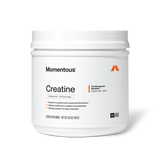
One scoop of Momentous Creatine monohydrate powder equals 5 grams of creatine.
One Momentous Creatine Chew equals 1 gram of creatine, so you can easily tailor smaller doses, such as 3 grams.
One Momentous Creatine Travel Pack equals 5 grams.

When you first start creatine, keep a few things in mind:
Mixing: Creatine monohydrate powder mixes best in a room-temperature or warm liquid. Some sediment is normal.
Loading phase vs starting with a maintenance dose: Training benefits show up after your muscles are saturated. Saturation occurs after one week with a loading phase and after about four weeks if you skip the loading phase and just take your maintenance dose.
Weight changes: You might notice a slight uptick in weight if you step on a scale. This increase is due to water weight stored in muscle.
Side effects: If you experience any gastrointestinal side effects, just split your daily dose into two servings taken at different times.
Figuring out the right dose of creatine for you doesn’t have to be complicated. You can determine your dose based on your goals or based on your body weight. Either works.
“For most healthy adults using creatine to support exercise performance and muscle strength, 3 to 5 grams of creatine monohydrate per day is a well-supported, practical dose,” Schacter says.
Larger bodies and heavy training may warrant about 5 to 10 grams, however.
You can take creatine at a time that works best for you, one that you’re likely to remember and stick to. For me, I add it to my morning smoothie out of autopilot habit and then go about my day.
Most people find that 3 to 5 grams of creatine per day, even on rest days, is sufficient. This is the general recommendation from the International Society of Sports Nutrition (ISSN). However, larger bodies and heavy training loads may require 5 to 10 grams. If you want a dose tailored to you, consider using your weight as a metric, another ISSN recommendation. Aim for 0.1 gram per kilogram (about 0.05 grams/per pound).
No, 10 grams of creatine is not too much. It falls within the recommendation of 5 to 10 grams for athletes with larger bodies.
You should drink your usual amount of water per day to maintain your hydration. Supplementing with creatine does not increase your fluid-intake needs.

Jennifer Chesak is an award-winning science and medical journalist, author, editor, and fact-checker with more than 25 years of experience.

Aston Dommel, RD, PhD, CSSD
Aston Dommel is a Registered Dietitian with over 8 years experience holding a PhD in Nutrition Sciences. Aston has worked with a wide range of populations, including tactical and special operations professionals, collegiate and professional athletes, and general populations.
Currently, Aston works with Momentous, where he works at the intersection of regulatory, clinical, and scientific affairs helping to advance evidence-based supplementation and human performance.
Recommended Products