Best Creatine for Women: What to Look For in 2027
|
Written by Jennifer Chesak and clinically reviewed by Aston Dommel RD, PhD, CSSD
The best creatine for females is the same as for males. Creatine is not a sex-specific supplement.
Creatine monohydrate is the most researched form. Although other forms exist, research doesn’t show they’re better.
A reputable creatine supplement will disclose all ingredients, list serving size and how many servings are included, and disclose third-party testing results and certifications.
The best creatine for you will also depend on the delivery format you prefer, such as powder, chew, gummy, or capsule, and whether you desire flavoring with your dose.
So you’ve heard the news: Creatine isn’t just for gym bros. Maybe you’ve even started searching for a supplement to add to your regimen. Some brands market creatine specifically to women for supporting the menopause transition, muscle health, and brain health. But what’s the best creatine for women?
Females can take the same creatine supplements as males. Formulations aren’t sex specific. What matters about a supplement is what’s on the label. But supplement labels can be confusing, especially with all the options out there.
In this article, we show you exactly what to look for in a creatine supplement and why.
Female-specific packaging means nothing when you’re looking for a creatine supplement. So you won’t find a “best creatine supplement for women.” Instead, the key things to look for on a label include that it’s creatine monohydrate, that it provides a clear amount per serving (and serving count), that it has undergone independent testing, and that it’s in the format you desire, such as a powder, gummy, or chew.
Why consider creatine in the first place? Creatine supports your body and brain. But the female body stores less of it. Females also tend to consume diets lower in creatine than males. Hormonal changes throughout the menstrual cycle and lifespan also impact how the female body accesses and uses creatine. Plus, female brains have energy demands that change with hormonal fluctuations, especially in perimenopause.
“A label-first checklist for choosing creatine”
|
Criterion |
What to look for |
How to verify |
Red flag |
||
|
Chemical form |
“Monohydrate” |
“Monohydrate” should be on the label and mentioned in the “ingredients” |
If it doesn’t mention monohydrate |
||
|
Creatine grams per serving |
“Grams per serving” and “serving size” |
Should be listed on the supplement facts label |
If the label doesn’t include these elements |
||
|
Ingredient transparency |
A complete ingredient list |
Should be listed on the supplement facts label |
If the label doesn’t disclose ingredients, says “proprietary” without listing the ingredients, or lists unnecessary additives |
||
|
Certification of the exact SKU |
“Third-party tested” |
The label might say this exact phrase, or it might list a certification, such as “NSF Certified for Sport,” “Informed Sport/Choice,” or USP Verified; to verify, search the certifier’s database using the exact product name and formulation |
If it doesn’t include any third-party testing information on the label or website; if it says it has been independently tested but it doesn’t disclose the testing results or certifications; if the certification applies to a different product; if it claims it is FDA-approved |
||
|
Cost per equivalent amount |
With the amount per serving and total amounts, you can calculate cost per serving |
Divide the product price by the total grams included in the package to calculate cost per gram; multiply this dollar amount by your desired serving size |
If the label doesn’t provide enough information for you to do this math |
||
|
Convenience |
A serving size, format (e.g., powder, chew, gummy, capsule, etc.), and preparation method (e.g., requires a liquid for mixing or you can take as is) that fits your routine |
|
|
The first thing to figure out regarding a supplement label is its chemical form. How you take your creatine is its delivery format, such as a powder, capsule, gummy, or chew. “Monohydrate” is a chemical form (type) of creatine. It “has been the most extensively studied and commonly used form of creatine in dietary supplements,” according to a 2021 research review published in the Journal of the International Society of Sports Nutrition.
“It has a long track record for being safe and effective for most healthy people,” says Leah Jones, MD, at Mochi Health. “Other forms, like creatine HCl or buffered creatine, are often marketed as better absorbed or easier on the stomach, but there isn’t strong evidence that they work better than monohydrate.”
Additionally, check that the supplement facts label tells you how much creatine is in the total package and how much is in a serving. This will help you dial in precise servings to get the most benefit.
Jones recommends products in which creatine monohydrate is the only active ingredient. “A simple ingredient list is a good sign,” she says. “Be cautious of ‘proprietary blends’ that don't list exact amounts.”
Next, verify that the product has been “third-party tested” and that it lists its findings and certifications.
The Food and Drug Administration (FDA) doesn’t regulate supplements the same way it regulates medications, according to 2019 research published in Current Sports Medicine Reports. Instead, it regulates supplements as foods. The onus is on a manufacturer to ensure safety and accurate labeling. If a supplement claims it is FDA-approved, that’s a red flag.
“Supplements aren't approved by the FDA before they’re sold,” Jones says, “so third-party certification is the best way to know what’s in the container.”
Third-party testing means an independent lab, not affiliated with the supplement brand, tests the product to ensure accurate labeling and that it meets standards for contaminants, including pesticides and heavy metals. After testing, a brand may receive a certification.
“Look for seals like ‘NSF Certified for Sport’ or ‘Informed Sport,’” Jones says, “which test for banned substances and contaminants and confirm the label matches what’s inside.”
“NSF Certified for Sport” and “Informed Sport” or “Informed Choice” are certifications that help ensure the product is free of any substances athletic organizations have banned. Other third-party certifications include USP Verified and “CL Seal of Approval” or “CL Approved Quality Product Seal.”
In many cases, a supplement may list its third-party testing results (or where to find them) right on its label or website. You should also be able to independently verify these results by looking up the exact product on the certification’s website. Third-party testing results and certifications apply to individual products, rather than a brand’s entire offerings.

Next, consider which delivery format you prefer for your creatine supplement: powder, chew, gummy, capsule, or travel pack.
“The best format is the one you'll take every day,” Jones says, “since creatine works by building up in your muscles over time.”
Your decision might come down to convenience. “Unflavored powder mixes easily into coffee, smoothies, or yogurt,” Jones says. You can purchase a powder in bulk, or you can buy a package of single-serving travel packs for on the go. Powders also come in various flavors if you prefer.
“Gummies are convenient and tasty,” Jones says. “Some products have been found to contain less creatine than the label says,” she adds. “If you choose gummies, third-party testing is especially important.” Gummies may also contain added sugar, something to consider if you’re trying to reduce your intake.
One more caveat regarding gummies. The manufacturing process for making gummies involves some heat. But 2025 research published in the journal Food Research International suggests creatine may degrade at certain temperatures.
Chews that are 1 gram can be a convenient way to get a precise lower dose if you aren’t taking 5 grams, which is a common serving size for creatine products. “Capsules are good for travel,” Jones notes. But some people have trouble swallowing capsules or pills in general. So that’s another consideration.
Your best creatine supplement choice after age 40 or 50 only changes if your preferred creatine format changes. However, creatine supplementation may become even more important during this midlife chapter, as it is the most common timeframe for going through the menopause transition.
More than 70% of females do not consume the recommended daily intake of creatine through diet. Adult females consume the least when compared to adolescents, according to research published in Food Science & Nutrition in 2024.
Your level of estrogen at any given time affects how your body metabolizes and uses creatine, as noted in a 2021 Nutrients article. Lower estrogen states, such as during the menopause transition and beyond, mean you may have an increased need for creatine.
The menopause transition is also a common time when females are focusing on preserving and building muscle. Research suggests creatine can support your efforts.
Untrained female participants in one study who took creatine while doing resistance training for 10 weeks experienced greater improvements in maximum strength when compared to participants who took a placebo. The strength gains were 20% to 25% higher for lower-body exercises, according to a 2021 journal article in Nutrients.

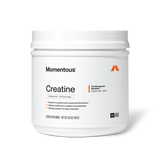
Obviously, this guide is Momentous written, and we want to be transparent about that. According to the criteria outlined above, here’s how Momentous creatine products stack up: Momentous Creatine Monohydrate Powder, Momentous Creatine Chew, and Momentous Creatine Travel Pack.
Before you start taking your creatine, be sure to check with your doctor. This is always a good idea before adding any supplement to your routine, especially if you have underlying conditions, take medications, or are pregnant or nursing.
Creatine is generally considered safe, including for females, according to 2020 a research analysis published in the journal Nutrients. The analysis included 58 studies with female-only participants. In studies that reported on potential adverse events, no serious issues were reported.
Keep in mind that creatine might change the number you see on your scale because it can add a little water weight to your muscles. Most creatine supplementation advice includes a loading phase. This is when you take 20 to 25 grams per day for about a week and then switch to a maintenance dose, usually 3 to 5 grams going forward. You can skip the loading phase and start directly with a maintenance phase if desired. This strategy can help reduce the risk of water weight gain. But it’s not a guarantee.
More and more females are turning to creatine for brain and muscle health support, especially during the menopause transition and beyond. Although you might come across brands that specifically market to women, creatine supplementation isn’t sex specific. Males and females can use the same creatine supplement.
To find a reputable brand and product, search for one that is creatine monohydrate (since that’s the most studied chemical form). Also consider a supplement that discloses all ingredients, includes serving sizes and how many servings per package, and features third-party testing results.
Although some brands market creatine to women, creatine supplementation isn’t sex specific. The best creatine for you will depend on your format preference, such as a powder, gummy, capsule, or chew. Other considerations include whether it’s creatine monohydrate, the most studied form. A reputable supplement will also disclose all ingredients and third-party testing results.
Yes, as long as a supplement, whether a gummy or a powder, contains creatine monohydrate, you’re getting generally the same thing. One caveat is that gummies usually contain added sugar. Some flavored powders also do. So you might prefer an unflavored powder if you need to reduce your added sugar intake. Additionally, making gummies involves some heat. But some research suggests creatine may degrade at certain temperatures.
To determine if your creatine supplement has been third-party tested, review the label or the brand’s product landing page on its website. A reputable supplement will disclose its third-party testing results. If the product is certified after independent testing, it will list this certification. You can verify the certification by going to the certifying organization’s website and searching for the exact product you are considering.

Jennifer Chesak
Jennifer Chesak is an award-winning science and medical journalist, author, editor, and fact-checker with more than 25 years of experience.
Recommended Products