Micronized Creatine vs Monohydrate: The Key Differences
|
|
Updated on June 16, 2026
If you’re interested in helping to improve muscular endurance and recovery, you may be considering two popular forms of creatine: creatine monohydrate and micronized creatine.
People looking for a clinically proven creatine powder often turn to creatine monohydrate, while those who prioritize a creatine supplement that’s highly soluble (easily dissolves) may reach for micronized creatine.
But there’s a lot more to know about these two forms of creatine, which is highly popular in the supplement space.
In this explainer, we take a closer look at these two forms of creatine, including their similarities and differences, and if one is truly more beneficial than the other.
Before we fully dive into the similarities and differences between creatine monohydrate and micronized creatine, let’s first start with what creatine is:
Creatine is an amino acid that plays a critical role in cellular energy production. Helping to boost your phosphate reservoirs, creatine also supports the creation of adenosine triphosphate (ATP) throughout the body. ATP is key to driving energy at the cellular level and supports fundamental functions from muscle movement to nerve cell growth.
The benefits of creatine monohydrate have been extensively studied and supported by a growing body of scientific research. Peer-reviewed studies have demonstrated its positive impact on physical performance, lean muscle mass development, strength, power, and cognitive function. That’s why creatine monohydrate is referred to as the gold standard of creatine supplementation.
Micronized creatine is made by breaking creatine molecules down into smaller particles. Due to the smaller particle size, bioavailability and solubility is said to be better with micronized creatine powders.
| Micronized Creatine | Creatine Monohydrate | |
|---|---|---|
| Effectiveness | Clinically proven | Clinically proven |
| Mixability | Small particle size = more soluble | Good solubility |
| Dosage | 3–5g/day | 3–5g/day |
| Form Factor | Powder only | Versatile (pills, powder, capsules) |
| Side Effects | None known | None known |
| Price | Typically more expensive | More affordable |
Micronized creatine monohydrate and regular creatine monohydrate may share the same amino acid, but they do differ in some ways:
Creatine monohydrate has the most extensive research base of any form of creatine with hundreds of peer-reviewed studies across decades supporting its benefits for strength, power, muscle growth, and cognitive function. This is why it's widely referred to as the gold standard of creatine supplementation. Micronized creatine shares the same active ingredient and delivers the same benefits; the micronization process affects particle size, not efficacy.
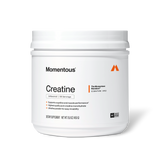
Solubility matters—nobody wants creatine clumping at the bottom of their glass. Standard creatine monohydrate can have a gritty texture and may not dissolve fully in water. Micronized creatine improves on this through smaller particle size, which increases solubility. Momentous® Signature Spec Creatine takes this further with a superior micronization process that produces an ultrafine powder (closer to powdered sugar than the granulated texture of standard creatine) that dissolves completely with no clumping, grit, or residue.
For most people, the research-supported daily dose of creatine is 3–5 grams. At this level, muscles can effectively absorb and store creatine without the digestive discomfort that can come with higher doses. This recommendation applies to creatine monohydrate, which has the most extensive dosing research behind it. Because micronized creatine is the same active ingredient processed to a smaller particle size, the same 3–5g daily target applies; there is no separate recommended dose for micronized creatine.
Creatine monohydrate is the most versatile form of creatine, available as a powder, capsules, chewable tablets, and travel packs. Micronized creatine is primarily sold as a powder, given that the fine particle size is most relevant in that format.
There are no major side effects linked to creatine monohydrate or micronized creatine.There are no major side effects linked to creatine monohydrate or micronized creatine. Some people experience mild initial water retention or digestive discomfort, particularly at higher doses, but this is uncommon with high-quality micronized products such as Momentous® Signature Spec Creatine.
Product prices vary depending on a few factors, such as the type of testing and processing a formula undergoes, as well as any certifications it garners. This is the case for all supplements. Generally speaking, micronized creatine may cost more since it undergoes additional steps to achieve its smaller particle size. Creatine monohydrate is generally more affordable.
Micronized creatine and creatine monohydrate share the same active ingredient—creatine—which studies have found may improve physical performance, enhance lean body mass development, increase strength and power, and support cognitive benefits such as enhanced memory and reduced mental fatigue. Additionally, these forms of creatine are both soluble and have a recommended daily dosage of up to 5g of creatine per serving.
The choice is yours. If your main goal is a highly soluble supplement, micronized creatine is worth considering. If you want the most widely researched, clinically validated option, creatine monohydrate remains the gold standard.
The good news: with Momentous® Signature Spec Creatine, you don't have to choose. It's creatine monohydrate—the most research-backed form—micronized into an ultrafine powder that dissolves completely with no grit or residue. You get the purity and proven efficacy of monohydrate with the superior mixability of micronized creatine, plus a manufacturing and testing standard that goes well beyond anything else on the market.
Sourced from the top 1% of global creatine production, manufactured in a pharmaceutical-grade facility, and verified through a six-stage testing protocol including NSF Certified for Sport® certification, Momentous® Signature Spec Creatine is the only creatine that answers both questions at once.
Research suggests taking creatine immediately after a workout may have a slight edge for strength and body composition, but the difference is modest. Consistency matters far more than timing: taking creatine at the same time each day, whether before training, after, or with a meal, is what drives results over time.
Most people notice improvements in training performance and muscle development within two to four weeks of consistent daily use. If you do a loading phase, muscle creatine stores saturate faster and you may notice benefits sooner (within the first week), although loading phases are typically associated with power athletes, such as bodybuilders or power lifters.
A loading phase involves taking 20g of creatine per day—typically split into four 5g doses—for five to seven days. This saturates muscle creatine stores faster than the standard daily dose and can accelerate the timeline to seeing results. However, for most people who are simply looking for physical and cognitive benefits, taking 3–5g daily produces the same end result, just over a longer period of around three to four weeks.
Yes, creatine monohydrate has one of the strongest long-term safety records of any supplement, with data from hundreds of clinical trials showing no adverse effects in healthy individuals. Daily use is not only safe but recommended, as consistent supplementation is what maintains elevated muscle creatine levels and sustains the performance and cognitive benefits.
Yes, and the evidence strongly supports it. Creatine benefits women across all life stages, with particularly meaningful research in peri and post-menopausal women, where it has been shown to support lean muscle mass, strength, and bone health when combined with resistance training. Cognitive benefits are also well-documented in women, particularly under conditions of stress or poor sleep.
The performance and muscle gains made while taking creatine are largely dependent on continued training and supplementation. If you stop taking creatine, muscle creatine stores return to baseline within four to six weeks, and some of the training advantages will diminish over time. The muscle you've built through consistent training is yours to keep; creatine supports the process, but the adaptations come from the work.
Yes, creatine is well-studied in combination with protein, carbohydrates, and amino acids, and stacking it with a high-quality protein supplement is one of the most evidence-backed combinations for muscle growth and recovery. There are no known negative interactions with common supplements. As always, quality matters: stack creatine with supplements that meet the same standard of third-party testing and ingredient transparency. Learn more about The Momentous ThreeTM: protein, creatine, and omega-3.
Some people experience a small initial increase in body weight, typically one to two pounds, in the first week or two, due to increased water retention in muscle cells. This is intramuscular water, not fat, and is actually a sign the creatine is working. Bloating is less common with high-quality micronized creatine and tends to be associated with lower-grade products or very high doses. Momentous® Signature Spec Creatine's ultrafine powder is designed to dissolve completely, which minimizes the digestive discomfort some people experience with standard creatine powders.
Grace Gavilanes
Grace Gavilanes is a writer-editor with over 10 years of experience in the wellness and lifestyle space. Her writing has been published in People, Well + Good, Glamour, Food & Wine, and more.
Recommended Products