How Long Does It Take for Collagen to Work?
|
|
Updated October 8, 2026
Collagen supplements take about eight to 12 weeks for most visible benefits, though improvements in joint and tendon health take longer — about three to six months.
Benefits for collagen supplements include joint comfort, tendon and ligament support, and skin health. There is less evidence for hair and nail benefits. Collagen does not improve muscle growth.
Early signs that your collagen supplement may be working include less joint pain, improvements in joint movement, and faster recovery, according to a sports dietitian.
It’s hard to wait. That’s absolutely true when you’re starting a new wellness habit like a daily collagen supplement and thinking how long does it take for collagen to work? So, you stand there looking at yourself in the mirror (maybe also doing a couple of squats just to see how it feels on your knees), but you’re seeing and feeling no difference. Then, the thought crosses your mind: Maybe all the internet skeptics were right, this supplement is all hype. That’s not a great feeling.
But seeing nothing after the first week is exactly what the studies predict. Keeping your expectations in check will help you know exactly what to expect so you can stick with the supplement long enough to know if it’s providing the benefit you’re looking for. We’ll explore how long it takes for collagen to work, give a realistic, study-backed window for each benefit you’re looking for, plus how to tell whether your collagen supplement is working.
How long does collagen powder take to work? Most clinical trials measure visible skin changes at eight to 12 weeks of daily use when taking a dose of 2.5 to 15 grams (g). Skin hydration may improve as early as four to six weeks, while joint benefits take longer at 12 to 24 weeks. If you don’t see any changes at weeks one or two, that’s normal—don’t panic.
Want to know exactly what to expect after starting collagen peptides? The below chart details a possible window of progress. Keep in mind that your results will depend on multiple factors, such as collagen supplement type (like marine vs bovine collagen), dose, age, baseline diet, and consistency.
When you take collagen, your body doesn’t just zip the peptides into your skin and tendons and voila, you have smoother skin and more resilient connective tissue. Instead, it is suspected that oral collagen works by signalling collagen-creating cells to produce more collagen, although more research is needed to know for sure. Another theory is that oral collagen provides a higher amount of the amino acids in collagen, so the increase comes from both the supply and the signal side. This process not only takes time to build up to a result that you see, feel, or experience.
Your skin renews on a cycle of about 28 days, which means that new skin cells that your body makes take about a month to fully migrate to the top layer of your skin. Connective tissue turns over slower.
That’s why seeing collagen benefits in one week just isn’t going to happen. Although it can be frustrating to wait, quitting at week two or three is expecting short-term results when you really need to play the long game.

Collagen does its best work when it’s taken consistently. That means if you’re starting a supplement, take it daily. Inconsistent doses will deliver inconsistent results, and you might peter out before you have the chance to derive real benefit. Here’s how to set your timeline expectations, accordingly, depending on your goal:
More supple, springy skin takes at least two months to see a real difference, according to a systematic review and meta-analysis of 26 randomized controlled trials on 1721 people taking hydrolyzed collagen, published in the journal Nutrients. What they found: For improvements in skin health, you need at least eight weeks of collagen use. In that analysis, benefits for skin hydration occurred around weeks four to six, while improved elasticity (the supportive structure in skin that resists sagging) needed eight to 12 weeks for best results. A more recent review, also published in Nutrients, also supported the timeline of eight to 12 weeks.
Generally, more hydrated skin is one of the first markers of collagen-producing skin changes. In one particular randomized, double-blind, placebo-controlled study, people who took 1 g of collagen peptides daily for 12 weeks benefitted from improved skin hydration values after six weeks and reduced appearance of skin wrinkling and elasticity after 12 weeks.
When to expect it: When it comes to how long does collagen take to work on skin, give your skin 8 to 12 weeks for visible improvement.
Joint and tendon repair requires you to play the long game as an athlete. Here’s what the research says about the benefit timeline: One earlier randomized controlled trial had 147 athletes on a varsity team or club sport take 10 g of collagen or placebo for 24 weeks. Published in the Journal of Current Medical Research and Opinion, men and women on the collagen supplement experienced an improvement in joint pain at rest and when standing, carrying objects, and lifting compared to the placebo group.
Another study in the Journal of Sports Science & Medicine evaluated 5 g of collagen for six months in people with chronic ankle instability, finding that those who took collagen for six months had improvements in ankle stability (imagine rolling your ankle less often) compared to the placebo group. In a three-month followup, the collagen group also showed a decrease in ankle sprains and fewer ankle injuries.
And finally, a third example: People with who took 2.5 g collagen for three months in combination with calf-strengthening exercises and a return-to-running program reduced pain and improved functioning during the rehab program, found a pilot study in Nutrients.
These studies above were all included in a 2021 review on 15 studies (12 of which were on recreational athletes) in Amino Acids, which found that, overall, collagen supplementation was effective in reducing joint pain, improving joint function, and increasing the length of time people performed strenuous exercise without pain, possibly because collagen increases type I, II, and IV collagen fibers, specialized proteins in connective tissue, and elastin production in cartilage to reduce tissue damage and pain, as well as having anti-inflammatory properties. “The study also noted that the benefits of collagen supplementation are best paired with restorative exercise for joint support,” says Jena Brown, RD, CSSD, a sports dietitian for endurance athletes and owner of Victorem Performance Nutrition in Brenham, Texas.
When to expect it: Three to six months when supplementing is paired with training.
Benefits for nails and hair are a bit shakier. For one, hair and nails are made up mostly of keratin, but collagen may support their health and growth in indirect ways, according to research in Nutrients.
One clinical trial in the Journal of Cosmetic Dermatology had 25 people take 2.5 g of a collagen peptide daily for 24 weeks. There was no placebo group, so the results are limited, but the researchers found that nails grew 12% faster, nails broke 42% less frequently, and 64% of people said that their nails were less brittle.
How long does collagen take to work on hair? Well, hair is far more difficult to provide an accurate estimated timeline for. Much of the research is either done on hair cells in a lab or on animals, which doesn’t provide the information we’re looking for here. In a study evaluating a supplement with collagen on two types of hair loss in people, this supplement helped improve hair growth when used as part of hair loss treatment for three months, per Sklin Research & Technology. However, the collagen supplement also contained amino acids, iron, and selenium,which will impact the results — not all the credit can be given to collagen alone.
When to expect it: Give it three to six months before assessing results.
Collagen may be made up of amino acids (the building blocks of protein), but unfortunately it’s not a muscle builder. A 2023 randomized clinical trial in Medicine & Science in Sports & Exercise found that 30 g of collagen protein taken after training did not successfully raise muscle protein synthesis. (Taking whey protein did.)
So what’s going on? “Even though collagen is traditionally derived from animal sources, it is not considered a high-quality complete protein, which is essential for muscle growth,” says Brown. “Collagen is best paired with other quality protein sources, such as whey protein, rather than by itself or as a protein replacement,” she explains. Here’s more about the differences between collagen vs whey protein.
When to expect it: Don’t count on collagen for muscle building.
Collagen is not a guaranteed fix for every problem. There are widespread issues with the breadth of research we have, as much of it is industry-funded. That does not automatically discount this research — funding like this is often necessary to produce science. However, there is certainly a risk of bias that we need to acknowledge.
A 2025 meta-analysis in The American Journal of Medicine found that in trials not funded by industry, the skin benefits (hydration, elasticity, wrinkles) were not statistically significant. This is a huge limitation of what we know (or think we know) about collagen.
However, it’s joint and connective tissue health that provides an opportunity for athletes to derive a real benefit. “Collagen supplementation appears promising, and it is a supplement I use daily as an athlete,” says Brown. “It is also a supplement I recommend as a sports dietitian working with endurance athletes because of the repeated stress on tendons and ligaments during training and racing,” she explains.
Collagen is not an adequate source of protein for women over 40, athletes, or anyone who’s looking to increase protein to promote muscle growth. You’ll want to look for a supplement that offers a complete protein, such as whey protein. For more about collagen and protein, read more on Dr. Stacy Sims on collagen.

To wrap everything up: How long does it take for collagen supplements to work? “Research currently supports a timeline of at least eight to 12 weeks for benefits,” says Brown. “Long-term supplementation has been deemed safe as long as supplement quality is prioritized. As a sports dietitian, I recommend athletes discuss their supplement stack with their dietitian or healthcare provider to ensure it aligns with their overall health and performance goals,” she says.
Take the dose that’s correct for you. Trials in skin and joint studies used 1 to 15 g per day, which is a wide range. In addition, taking collagen with vitamin C has been shown to improve collagen synthesis, per The American Journal of Clinical Nutrition. This was done in a very small study (on eight healthy men), but in general it’s been established that one of vitamin C’s many roles is that it’s needed for the protection of collagen, per the National Institutes of Health.
As for when to take collagen, make sure you’re taking it regularly. Take collagen 30 to 60 minutes before exercise, and on rest days take it before bed. And remember to keep collagen supplementation in context: as part of your performance plan — not the only highlight. “Other aspects of change may have a greater impact or enhance the benefits of collagen supplementation,” she says. One example is adding whey protein and collagen powder to a fresh fruit smoothie, which can pack a range of nutrients that support your goals, adds Brown.
As for the best collagen for athletes, choose one of the third-party tested supplements. Early signs that your collagen supplement may be working include less joint pain, improvements in joint movement, and faster recovery, says Brown.
If you haven’t experienced any benefits after consistently taking collagen daily for 12 weeks, it’s reasonable to reassess your goal, which may include moving on from oral collagen altogether.
Research points us to potential benefits, dosages, and appropriate timelines for collagen supplement benefits, with studies suggesting skin benefit around weeks eight to 12, tendon and ligament benefit in three to six months, and hair and nails possibly benefitting after three to six months, though that’s less certain. It’s unlikely that collagen peptides will help you build muscle, since they are an incomplete protein. That means that you’ll need to get your expectations for results in check and then honestly assess how the supplement may or may not be helping you. Be sure to take a supplement daily and with vitamin C to enhance results.
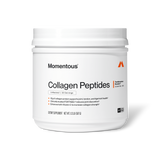
Using a high-quality hydrolyzed collagen peptide daily like Momentous Collagen Peptides, which has an adequate dose (10 g of collagen), as well as vitamin C to support collagen synthesis, is the best way to try out collagen and see what it can do for you.
Pu et al. (2023). “Effects of Oral Collagen for Skin Anti-Aging: A Systematic Review and Meta-Analysis.” Nutrients.
Al-Atif (2022). “Collagen Supplements for Aging and Wrinkles: A Paradigm Shift in the Fields of Dermatology and Cosmetics.” Dermatol Pract Concept.
Clark et al. (2008). “24-week collagen hydrolysate RCT in 147 athletes with joint pain.” Curr Med Res Opin.
Myung et al. (2025). “Effects of Collagen Supplements on Skin Aging: A Systematic Review and Meta-Analysis of Randomized Controlled Trials .” The American Journal of Medicine.
Shaw et al. (2017). “Vitamin C-enriched gelatin before intermittent activity augments collagen synthesis.” Am J Clin Nutr.
Praet et al. (2019). “Oral Supplementation of Specific Collagen Peptides Combined with Calf-Strengthening Exercises Enhances Function and Reduces Pain in Achilles Tendinopathy Patients.” Nutrients.
Recommended Products