Creatine for Cardio: What the Science Actually Says
|
|
Updated June 30, 2026
For years, creatine has been branded as the supplement for bodybuilders and lifters, something you take to build muscle, push heavy weight, and pack on power. So naturally, if your training is mostly running, cycling, rowing, or any form of steady-state cardio, you might have assumed creatine had nothing to offer you. Maybe you were even told it could bring adverse effects by adding water weight or slowing you down.
But here’s the surprising truth: emerging research shows that creatine may benefit endurance athletes and cardio-focused individuals in ways the old narratives never accounted for. Not because it magically turns you into a better marathoner, but because most real-world cardio isn't purely aerobic. It involves surges, sprints, hills, and high-intensity efforts that rely on energy systems creatine directly supports.
Let’s break down exactly when creatine helps cardio, when it doesn’t, and how to decide whether it makes sense for your training, backed by clear science, practical guidance, and the nuances that many discussions about creatine and cardio miss.
To understand whether creatine fits into your cardio routine, you need a basic sense of how it works.
Creatine is stored inside your muscles as phosphocreatine. During short bursts of intense activity, your body uses phosphocreatine to rapidly regenerate ATP (adenosine triphosphate), the molecule your cells use for energy. This system is incredibly fast but burns out quickly, typically in under 30 seconds.
Your body naturally makes some creatine and you can get some from eating meat or fish (but you’d need a lot to hit your optimal daily intake, which is why creatine supplementation is important, and especially so for vegans). Supplementation simply saturates your muscle creatine stores beyond what diet alone can accomplish, giving you a larger reserve of quick-access energy.
Creatine helps most during short-duration activity such as intense, anaerobic efforts, not during long, easy aerobic work. Yet as most cardio involves a blend of both, that’s where things can get interesting.
Before diving into specific sports, let’s look at different types of cardio and the energy systems that are used:
Anaerobic exercise relies on quick energy with limited oxygen. Think sprints, hill repeats, or explosive surges. This is where creatine shines because those efforts rely heavily on the phosphocreatine system.
Aerobic exercise relies on slower, oxygen-supported energy pathways. Think steady-state running and long rides. Creatine has less direct influence here.
But most cardio isn’t purely one or the other. It’s a blend, and creatine’s benefits can appear at the points where intensity spikes.
Below is a breakdown of how creatine influences different types of cardio.
This is the category where creatine’s benefits are strongest and most consistent. Research repeatedly shows that creatine supplementation improves:
Recovery between efforts
Overall sprint speed
Whether you’re running, cycling, swimming, or rowing—if you’re doing sport-specific sprints then creatine’s effects can help performance and recovery.
It works because sprinting is almost entirely anaerobic. Your muscles rely heavily on phosphocreatine to regenerate ATP at high speed, and once those stores deplete, your performance drops sharply. By saturating your muscles with creatine, you can extend the period of high-power output and recover more quickly between bouts.
If your training includes track intervals, hill repeats on the bike, fast 25s or 50s in the pool, or any kind of short, sharp, all-out effort, then creatine can play a crucial role in improving performance.
HIIT (high-intensity interval training) is built on alternating intense work periods with recovery. Those high-intensity intervals, whether on a bike, rower, treadmill, or in a weight training or circuit session, tap deeply into the phosphocreatine system.
Studies show that creatine can help you:
Recover more quickly between rounds
Produce more power during the working periods
There is nuance, though: HIIT itself is so physiologically potent that some studies show only modest additional benefits from creatine in the short term. However, over longer training blocks (4–8+ weeks), creatine often helps athletes sustain quality across sessions, supporting significant improvements in overall adaptations.
If your weekly routine includes Peloton intervals, CrossFit-style metcons, F45, OrangeTheory, or any structured interval or strength training, creatine can be a smart addition.
Some might argue that this is where creatine’s role can get really interesting, as mixed-intensity cardio typically involves efforts that combine aerobic endurance with anaerobic bursts. Recovery from those anaerobic bursts can be hugely significant in sustaining optimal overall performance.
Examples include:
800m–1500m track racing
Soccer, basketball, hockey
Hybrid training like CrossFit WODs and Hyrox
In these activities, creatine supports the anaerobic moments that make the difference between competing and performing:
Middle-distance runners get an extra boost for surges and final kicks.
Team-sport athletes improve their sprint-and-recover patterns.
CrossFit and Hyrox athletes see better peak power and reduced fatigue accumulation.
Your aerobic base handles the sustained work while creatine helps you crush the explosive parts within that aerobic foundation.
Cycling is one of the most compelling examples of how creatine benefits endurance performance, not because it directly helps steady-state riding, but because it can enhance the decisive moments of some races where surges and sprints are key.
Creatine may support:
Sprint finishes
Attacks and breakaways
Hill surges
Repeated high-power efforts during climbs
Improved recovery between intervals during training blocks
Depending on the cycling discipline (e.g., criteriums, stage races), races and training rides can be full of spikes and surges where your capability to get out of the saddle, deliver close to maximal watts, and then recover can make or break a race. And since sprint-type cycling relies heavily on phosphocreatine, creatine supplementation can provide meaningful advantages in these moments.
This category includes sports such as:
Marathon running
Long-distance cycling
Distance swimming
Ironman triathlon
This is the category where creatine has the least direct performance impact.
Purely aerobic efforts rely on oxidative energy pathways, not phosphocreatine, so creatine does not increase your pace, power output, or endurance in a traditional sense. But that doesn’t mean it offers zero benefits for endurance athletes.
Creatine offers two indirect benefits:
Improved recovery between training sessions
Creatine may reduce muscle damage and inflammation, helping you bounce back quicker between long or intense sessions.
Preservation of fast-twitch muscle fibers
High-volume endurance training tends to atrophy fast-twitch fibers. Creatine may help preserve them, supporting sprint ability for surges and race-day kicks.
Creatine doesn’t help you hold a steady pace better, but it helps you handle the moments that break steady pace, and helps your body recover so you can train at a higher quality overall. And in all of the sports listed above, even those that are 10+ hours in duration, there are often race-defining moments that involve sprints and surges, which is where creatine supplementation can offer huge benefits for endurance athletes.
Beyond direct performance effects, creatine offers several advantages that endurance athletes might sometimes overlook.
Studies show that creatine may reduce markers of muscle damage (like creatine kinase) and inflammation after prolonged or intense exercise. That matters because endurance athletes often walk the line between productive training and excessive fatigue.
Faster recovery means:
Higher-quality training sessions
Better consistency
Improved long-term adaptations
This is especially useful during peak marathon prep, heavy race blocks, or multi-day events.
When taken with carbohydrates, creatine has been shown to enhance glycogen resynthesis, your muscles’ primary fuel source for endurance exercise. That’s a powerful combination for:
Back-to-back training days
Training 2-3 times per day
Race weekends or stage races
Long runs or long rides requiring rapid recovery
Pro tip: Take creatine with your post-workout carb-rich meal to maximize glycogen replenishment.
Creatine is one of the safest and most well-researched supplements, but there are a few considerations for cardio athletes.
Creatine may increase intracellular water content by 1–2 kg during the first week of supplementation (especially during a loading phase). This isn’t “bloating” or “puffiness,” it’s water pulled into the muscles.
For most athletes, this is not performance limiting. In fact, intracellular hydration can improve muscle function and thermoregulation. But for:
Runners in hot conditions
Climbers facing steep elevation
Athletes in weight-class sports
…that extra water weight may feel undesirable. Using a no-loading protocol (3–5g/day) helps minimize this effect.
Some people experience:
Bloating
Cramping
GI upset
This is more common when taking high doses (like loading phases) or when creatine is not fully dissolved.
Solutions:
Use creatine monohydrate powder (not gummies or capsules)
Mix thoroughly in water
Split the dose throughout the day
Take with food
These strategies usually solve the problem.
Here’s how to implement creatine effectively and simply.
For most cardio athletes, the recommended approach is:
Daily Dose (No Loading Needed)
3–5 grams of creatine monohydrate daily
Takes ~28 days to reach full saturation
Minimizes water retention
Easiest long-term protocol
This is the method that’s most commonly recommended for endurance athletes.
Loading Phase (Optional)
If you want faster results:
20–25g per day split into 4–5 doses for 5–7 days
Then 3–5g daily maintenance
You’ll saturate muscle creatine stores more quickly, but may see more initial water retention and other side effects.
Creatine timing matters far less than consistency.
General guidance:
Take creatine anytime, as long as you take it daily
Co-ingesting with carbohydrates may increase uptake
Many athletes prefer post-workout with their recovery meal
But again, the biggest factor is simply consistency.
Creatine monohydrate is the gold standard. It is the most researched, safest, most cost-effective, and widely proven to increase creatine stores in muscle cells.
Other forms of creatine, such as HCl, nitrate, and micronized, have little to no evidence showing they outperform monohydrate.
For quality and purity, look for supplements tested by NSF or Informed Sport.
If you’re considering adding creatine to your cardio training, choose a product that is clean, reliable, and backed by research.
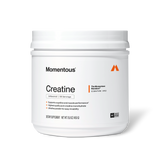
Momentous® Signature Spec Creatine sets a new bar for purity and quality.
Sourced from the highest-quality global creatine production and manufactured in a pharmaceutical facility using reverse-osmosis water purification, it delivers 10x fewer impurities and 2–5x stricter heavy metal limits than standard creatine.
Every batch is verified through a six-stage testing protocol and NSF Certified for Sport®, so you know that what's on the label is exactly what's in the bottle. No additives, no sweeteners, no compromises. Also available as convenient 15-Travel Packs in unflavored or lemon flavor for on-the-go supplementation.
For a no-mix option, Momentous Creatine Chews deliver the same Momentous Standard® of quality in a portable, chewable format.
Each pressed-powder tablet provides 1g of pure creatine monohydrate, for flexible dosing and consistent potency. They’re also NSF Certified for Sport® and contain no artificial colors or sweeteners.
Available in three flavors—Lemon-Lime, Strawberry, and Mango—in 150-count tubs or 3-flavor variety packs.
Whether you're training, traveling, or at the office, consistency has never been easier.
Emma-Kate Lidbury
Emma-Kate Lidbury is a freelance writer and editor with 20 years of experience working in the health and fitness world.
Recommended Products